Video Transcript
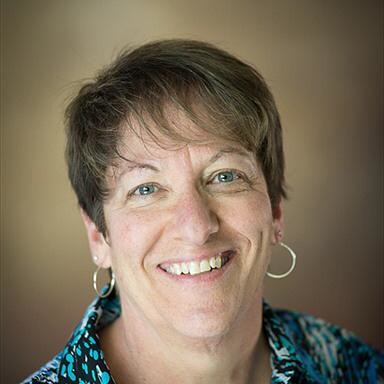
Katie Miller shares her experiences with VABVI Children’s Services. The video opens with an exterior shot of the Vermont Association for the Blind and Visually Impaired offices in South Burlington, Vermont. In the scene that follows, Katie Miller—a mother with brown hair and glasses, wearing a blue shirt and illuminated by a window above her right shoulder—begins to speak. She explains that she and her husband, Steven, have a daughter named Maggie, who is one and a half years old. When Maggie was born, she had a full head of white hair, which was a big surprise, and she was diagnosed at birth with albinism. This means that Maggie does not produce pigment in her skin, hair, or retina.
Part of Maggie’s visual impairment is caused by this lack of retinal pigment. She also experiences photophobia, making her very sensitive to bright light; nystagmus, where her eyes shake back and forth; and strabismus. On top of that, the way she sees the world is different. Katie explains that she wishes she could experience Maggie’s vision firsthand to truly understand what she sees. The best explanation they’ve been given is that Maggie sees the world like a low-resolution picture—rather than a crisp, high-definition image, it’s more like someone reduced the resolution so the picture appears fuzzy, made up of large pixels. Maggie can also have typical vision-related issues that might be helped with glasses, but most aspects of her impairment cannot be corrected with surgery or lenses. They were told early on that Maggie’s range of sight, her acuity, could be anywhere from 20/400 to 20/40 best-case scenario with correction. It was a huge shock. Both Katie and her husband are artists, and like many expecting parents, they had envisioned a “normal” future. Adjusting to a new understanding of Maggie’s future was challenging.
But Maggie is just like any other child—she simply sees differently. A major part of learning about her vision and how to support her has come from working with the Vermont Association for the Blind and Visually Impaired. Shortly after Maggie’s birth, they were connected with services through early intervention and their pediatrician. Around three or four months old, a TVI (Teacher of the Visually Impaired) began visiting their home once a month. Katie says that when the TVI walked through the door for the first time, it felt like gaining a new family member. She made them feel comfortable, helping them as new parents understand what it meant to raise a child with low vision, and showing them how to support Maggie in learning, engaging with her environment, and adapting to the world around her.
Katie says she doesn’t know where they would be without their TVI, especially in the beginning when everything felt uncertain. Although no one can predict the future, their TVI had worked with many other children and could give them a clearer sense of what to expect. As parents of a child with a disability, all they want is for Maggie to learn, grow, and explore her world to the best of her ability. Katie firmly believes that they would not be where they are today without their TVI and the community connections they’ve made with other parents of children with disabilities—many of which they were introduced to through VABVI.
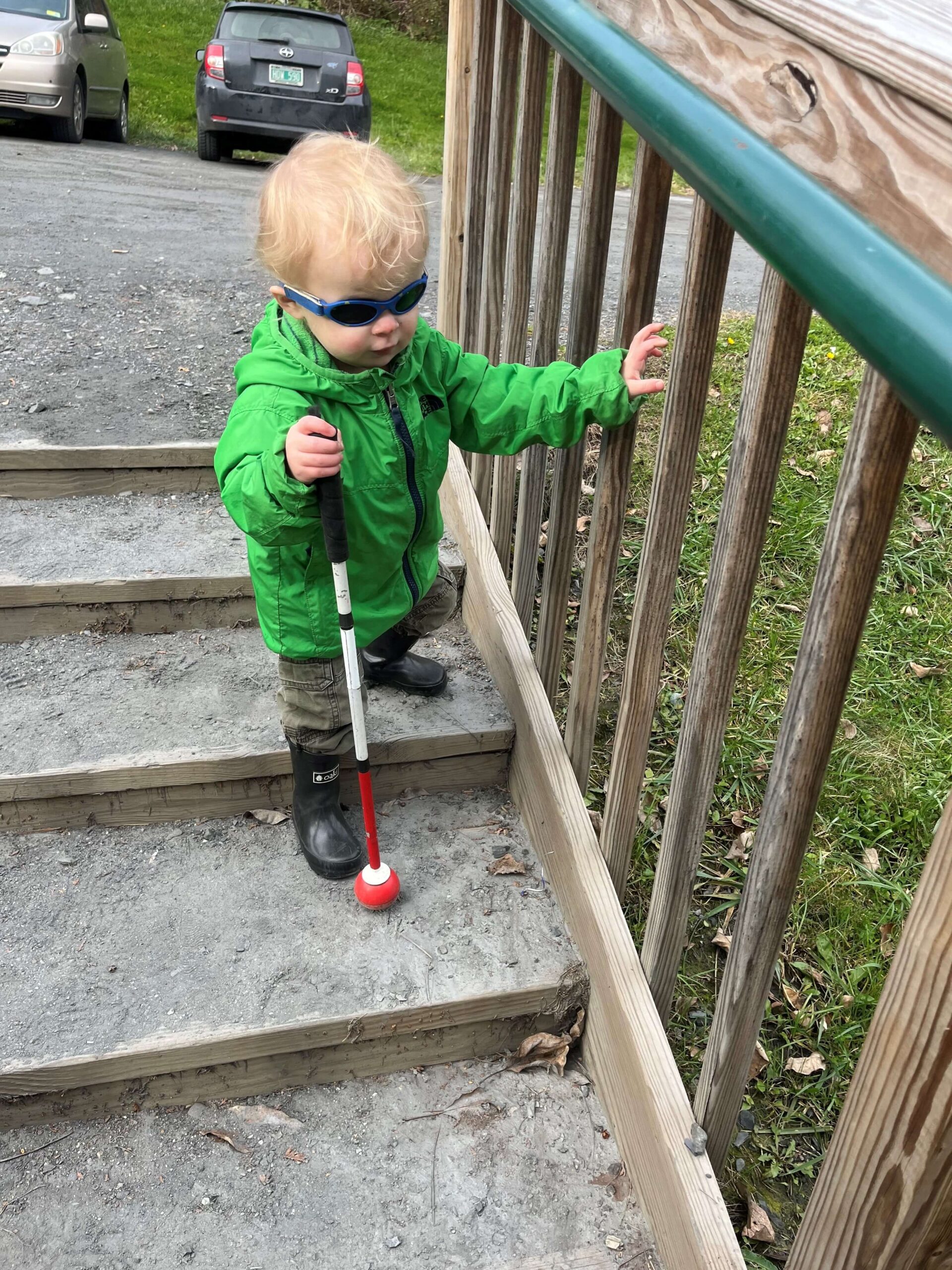
Looking ahead, Katie finds comfort knowing that the TVI will continue to support Maggie throughout her development. Now that Maggie is eighteen months old, walking and climbing, her low vision brings additional challenges. They often need to adapt their home or childcare environments to make them safe and navigable for her, and their TVI has guided them through all of it—things Katie says she would have no idea how to do on her own. She is grateful for the support and excited for the future with VABVI by their side.